
Build a flight by dragging cargo into containers
The lying list on one side, the ULDs on the other and drag between them. A waybill can be split across containers.
Lying list
Cargo waiting in the warehouse, split into what is available now and what is still pending, each card carrying pieces, weight and volume.
Split
A shipment too large for one ULD, or one that has to travel in parts, splits on the card. The pieces stay tied to their waybill, so the count still reconciles at the other end.
Containers, bulk load and offloads
Not everything travels in a ULD. Bulk load has its own tab and cargo that came back off the build stays visible.
Locking the build
The build locks when finalised, with an undo and a history behind it.
Progress
Build-up progress sits on the flight card.
Load planning
Each flight's loading instruction: the ULDs on the main and lower deck, their contour and handling codes, the waybills planned into each, and how full each one is by weight and volume. Every published version is kept.
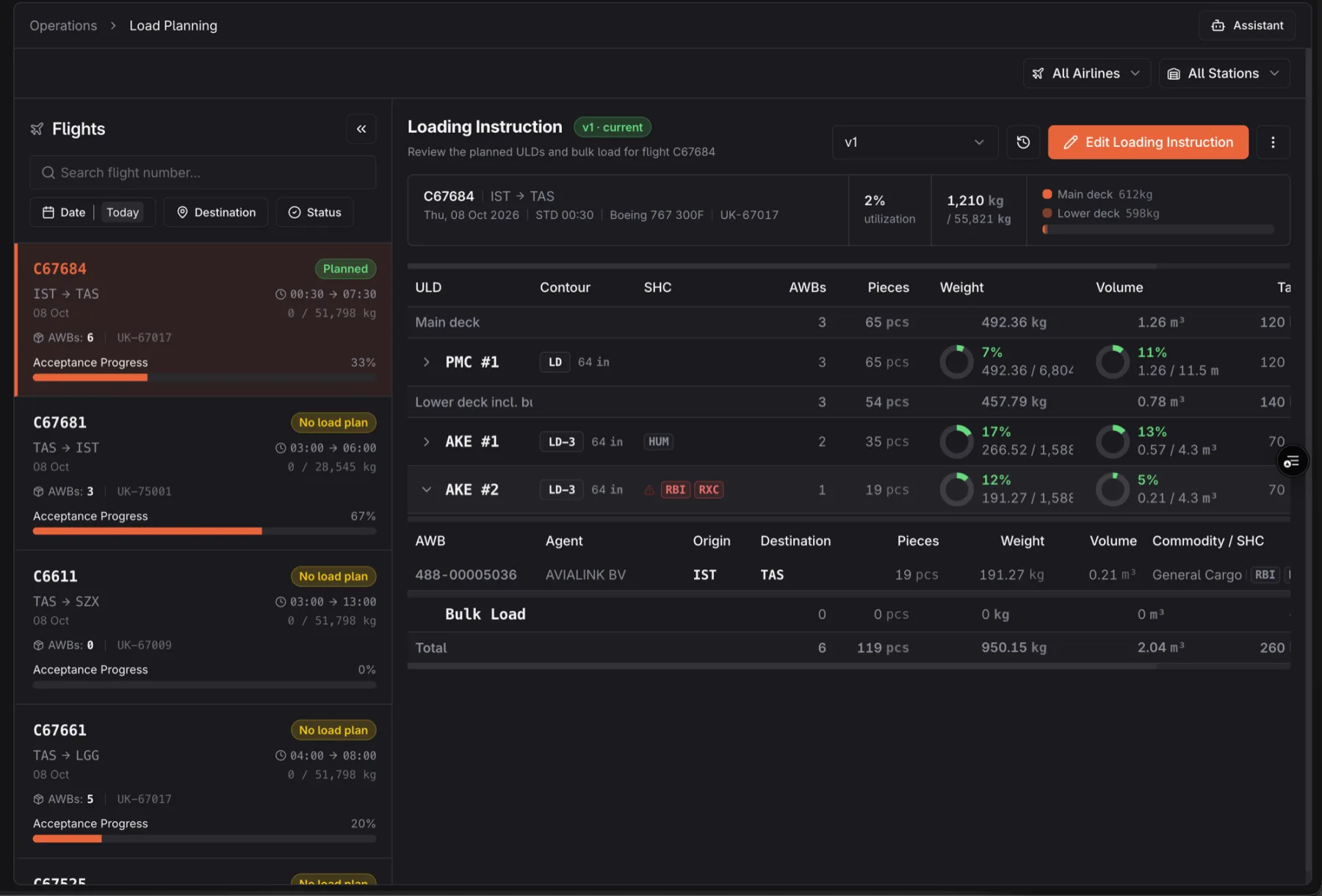
The loading instruction, printed
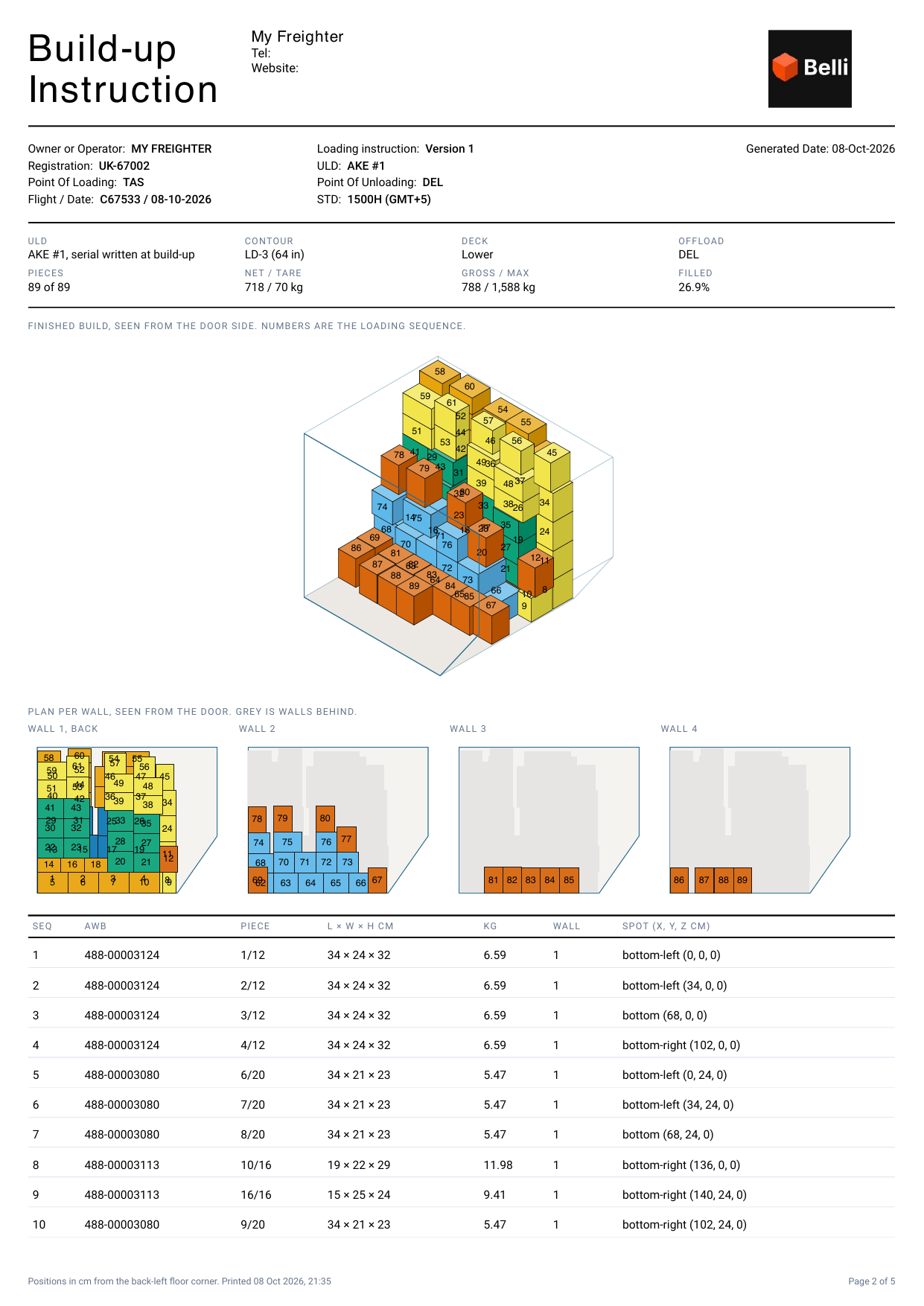
Publishing produces the sheet the ramp works from: the ULDs, their waybills and the deck weights, then a build-up sheet for each ULD with the finished build, a plan per wall and every piece in loading order.

How the 3D build-up works
The design behind the build-up sheet: how pieces are packed inside the ULD's real contour, the rules every build is checked against, and a live 3D build you can step through piece by piece.
- Starts from
- AWB lines already planned into a ULD in the Loading Instruction. Assigning AWBs to ULDs works as it does today.
- Produces
- A 3D build per ULD with a loading sequence for every piece, and a build-up sheet per ULD in the Loading Instruction PDF.
- Checks against
- The ULD's real contour and door, accepted dims, the airline's SHC rules and the planner's dangerous goods checks.
How it packs
Each ULD is a 3D bin-packing problem with cargo rules attached. Exact solvers prove optimal builds only for small instances, so Belli uses the extreme-point heuristic that published ULD systems use: place one piece at a time at the best legal spot, run that many times with shuffled orders, and keep the best build. A 50-piece pallet builds in about 0.2 seconds, and the same seed always gives the same build.
- Envelope
Containers use the ULD's own profile (an AKE has a 156 cm floor that widens to 201 cm from 64 cm up) over its 153 cm depth, with the door on the profile face. Pallets use the base up to the position's build contour (LD 163, Q6 244, Q7 300 cm), with 5 cm net clearance in the bottom 15 cm.
- Pieces
Each AWB line becomes boxes: accepted dims first, booked dims second, then dims the planner types in the 3D view. Lines with no dims wait in the AWB list until someone enters them. Weight per piece comes from the dims line, otherwise the AWB's planned weight split by volume. Handling marks (no stack, this way up) are set per AWB line.
- Pre-checks
SHC rules for the ULD, one offload station, door opening, max gross weight and floor load. Anything that fails is listed before packing, never dropped silently.
- Order
AWB groups go heaviest and densest first, larger bases first inside a group, no-stack and live animal groups last.
- Place
Containers build walls from the back to the door: each wall takes the depth of its leading piece, heavy pieces fill its bottom rows, lighter ones fill up to the contour. Pallets build level layers: each layer takes the height of its leading piece, shorter pieces stack up to the layer top so the next layer sits flat, then the build is centred on the base. Inside a wall or layer, each piece takes the lowest, deepest, leftmost legal spot, preferring the one touching the most surface. A no-stack piece goes where it wastes the least headroom.
- Search
Repeat about 50 times, varying which piece sets each wall depth or layer height, swapping groups of similar weight and adding a little noise. Keep the best build by placed volume, then unplaced pieces, centre of gravity offset and height, heavy-on-light stacks, and AWB pieces left on their own.
- Sequence
A piece waits for everything it rests on and, in a container, everything behind it that it would block. Containers load wall by wall from the back to the door, bottom up; pallets layer by layer, centre out. Ties keep the same AWB together. Every piece gets a sequence number and "piece 3 of 8".
The rules every build is checked against
| Rule | Kind | Default |
|---|---|---|
| Inside the contour | HARD | Pallets keep 5 cm net clearance below 15 cm |
| No overlap; nothing on no-stack or live animal pieces | HARD | |
| Base support of a stacked piece | HARD | 75% for cartons, 100% from 150 kg |
| This way up | HARD | Turns on the floor only, unless the piece may tip |
| Container door and wing | HARD | Fits the door (AKE 147 × 155 cm); the wing takes pieces up to 30 kg |
| Max gross weight, floor load | HARD | ULD type max; AKE 976, PMC 1,952 kg/m² |
| SHC rules set to Block | HARD | Set per airline in settings |
| Cargo-aircraft-only dangerous goods | HARD | On an outer face, labels out |
| Pallet centre of gravity | WARN | Within ±10% of width and length, height up to 122 cm |
| One offload station per ULD | WARN | Mixed stations: first-off pieces at the door or on top |
| Heavy pieces low | STRATEGY | Bottom rows of every wall; the base layer of a pallet |
| Dense centred, AWB together | SCORE | Shapes the choice, never blocks |
Walls for containers, layers for pallets
A container is loaded through one door, so it fills from the back wall forward and each wall must stand on its own before the next. A pallet is open on all sides and netted, so it rises in level layers: each layer gives the next a flat floor and keeps the outer faces square for the net.
Manual edits
Drag a piece across the floor: it snaps to neighbouring faces and settles on whatever is below. Every move re-runs the hard rules and the sequence. Lock keeps a piece where it is; Re-optimize repacks only the unlocked pieces around it.
Why not an exact optimiser
3D packing is NP-hard. Exact solvers prove optimal builds only for small instances and cannot explain their answer. The heuristic runs in a fraction of a second, every rule is a readable check, and a planner can see why a piece went where it did.
Sources for defaults
IATA ULD specs, AirBridgeCargo and Nippon Cargo build-up guidelines, the IATA DGR and AHM 333. An airline's own loading charts replace them.
Try it on two sample ULDs
An AKE container and a PMC pallet, packed live in your browser. Scrub the loading sequence, click a piece to inspect it, drag the selected piece to move it, lock it, then re-optimize the rest. Ctrl + scroll or the buttons zoom.
Loading the 3D view…
The build-up sheet
One page per ULD in the Loading Instruction PDF: the manifest header, the finished build, a plan per wall (per layer on pallets), the loading sequence and a sign-off box. This one is drawn from the same sample AKE as above; long ULDs continue the table on a second page.
Printed 07 Oct 2026 14:20
The research behind it
What it is called. An extreme-point heuristic run inside wall building for containers and layer building for pallets, with deepest-bottom-left placement, as a randomized greedy search, with the loading sequence from a topological sort.
Which problem it solves. Operations research calls it the 3D container loading problem, a form of 3D bin packing. Air cargo literature calls ULD build-up the Air Cargo Palletization Problem, one of four parts of load planning next to aircraft configuration, build-up scheduling, and weight and balance (Brandt & Nickel 2019).
Why the order matters. A greedy packer never revisits a choice, so the order it is fed decides the result. Every strong method searches over orders and reuses one placement rule to turn each order into a layout.
- Extreme pointsCrainic, Perboli & Tadei 2008
- Candidate spots. When a box lands, its far corners slide back toward the origin until they touch something. About six per box, and locked boxes are supported.
- Walls and layersGeorge & Robinson 1980; Bischoff & Ratcliff 1995
- Containers fill wall by wall from the back; pallets fill in level layers. Inside each, the lowest, then deepest, then leftmost spot wins.
- Randomized greedy search
- Run the greedy packer many times with shuffled orders and a little noise, score each whole build, keep the best.
- Topological sort
- Order the pieces so each comes after everything it rests on or would block. Ties pick the wall, the layer and the AWB.
Other algorithm families
| Family | Key work | How it works | Fit for Belli |
|---|---|---|---|
| Extreme points in walls or layers, randomized greedy OURS | Crainic et al. 2008; Heßler et al. 2024 | Fill walls (containers) or layers (pallets) one piece at a time at the best legal spot, repeat with shuffled orders, keep the best build | A fraction of a second per build, every rule is a readable filter, handles contoured ULDs and locked pieces |
| Exact: MIP, branch and bound, constraint solvers | Martello, Pisinger & Vigo 2000; Paquay et al. 2016 | A solver searches box positions under no-overlap constraints and proves the best answer | Optimal, but only small instances finish in practical time. Useful offline, to measure the heuristic's gap |
| Wall building | George & Robinson 1980 | Fill vertical walls from the back to the door, one box type per wall | The container strategy, with extreme points inside each wall to handle mixed cargo |
| Layer building | Bischoff & Ratcliff 1995 | Stack horizontal layers of similar height | The pallet strategy; short pieces stack up to the layer top to keep it level |
| Block building + search | Parreño et al. 2008; Fanslau & Bortfeldt 2010; Araya et al. 2017 | Group identical boxes into blocks, place blocks into empty cuboid spaces, search over the choices | Best on the standard benchmarks (about 90 to 96% fill). Blocks of one AWB keep it together. Seconds to minutes per build |
| Evolve the order | Gonçalves & Resende 2013 | A genetic algorithm evolves box order and orientation; a placement rule turns each one into a layout | A natural upgrade: it reuses the same placement code |
| Heightmap (2.5D) | Robotic palletizing | Track a grid of heights and place where the surface stays flattest | Gravity and support come naturally, but no overhangs |
| Deep reinforcement learning | Zhao et al. 2021, 2022 | A neural network picks each placement, trained in simulation | Built for robots that cannot see the next box. A planner knows every piece, and the network cannot explain itself |
| Stability and sequence | Ramos, Oliveira & Lopes 2016 | Physics-based stability check, then the real loading order from a finished layout | A finer stability test than a flat share of the base; confirms the sequence-after-layout approach |
Closest published work
Paquay, Limbourg & Schyns, 2018
Extreme points extended to contoured ULDs, with fragility, stability, orientation and weight capacity. A second phase picks which ULD types to use.
Heßler, Hintsch & Wienkamp, 2024
DB Schenker. Extreme points inside a randomized greedy search for cuboid and contoured ULDs, with stability, non-stackable items and CG limits. Reports better utilization than Paquay. The same design as Belli's.
TU Delft thesis, 2024
A MIP for small builds and an extreme-point heuristic for large ones, then scheduling the builds across warehouse workstations.
Sources
- Crainic, Perboli & Tadei 2008, extreme point heuristics (INFORMS JOC)
- Paquay, Limbourg & Schyns 2018, two-phase heuristic for ULDs (EJOR)
- Heßler, Hintsch & Wienkamp 2024, real-life air cargo 3D packing (arXiv)
- Brandt & Nickel 2019, the air cargo load planning problem (EJOR)
- TU Delft 2024, palletization and build-up scheduling
- Parreño et al. 2008, maximal-space GRASP (INFORMS JOC)
- Fanslau & Bortfeldt 2010, tree search for container loading
- Araya & Riff 2014, beam search for container loading
- Gonçalves & Resende 2013, genetic algorithm for 2D and 3D packing
- Ramos, Oliveira & Lopes 2016, physical packing sequence (ITOR)
- Bortfeldt & Wäscher 2013, constraints in container loading (EJOR)
- Zhao, Yu & Xu 2022, online 3D bin packing (ICLR)
- George & Robinson 1980, wall-building heuristic
- Zhao et al. 2016, comparative review of 3D container loading algorithms